Training Volume Landmarks: How to Find Your Personal Volume Sweet Spot
The textbook says 10 to 20 sets a week. That's an average, not your number. Here's how to use MEV, MAV, and MRV to find the set count that actually works for you.
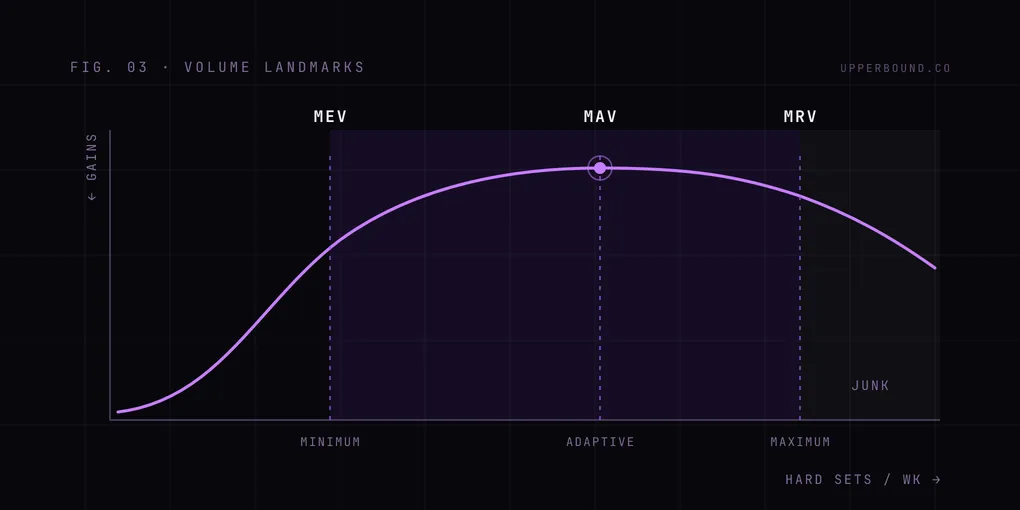
Open any hypertrophy guide and you’ll get a number: ten to twenty hard sets per muscle per week. It’s a fine starting point and a terrible stopping point, because it’s an average pulled across hundreds of people who recover nothing alike. Your number lives somewhere inside a personal range, and the volume landmarks (MV, MEV, MAV, MRV) are just labels for the edges of that range. Find your edges and the textbook average becomes what it should have been all along: a first guess you correct with data.
Key Takeaways
- Volume drives growth on a graded curve: each added weekly set produced about 0.37% more muscle in a 2017 meta-analysis, but the gains flatten as you climb (Schoenfeld et al., Journal of Sports Sciences, 2017).
- The four landmarks (MV, MEV, MAV, MRV) mark the floor, the productive middle, and the ceiling of your weekly sets. The popular per-muscle numbers are practitioner heuristics, not study outputs.
- Your sweet spot is personal and it moves. Response to the same program ranges wildly between people, so you find your landmarks by testing, not by copying a chart.
What are training volume landmarks?
Volume landmarks are four reference points on the curve that connects weekly sets to muscle growth, and that curve is real: a 2017 meta-analysis found a graded dose-response where each additional weekly set added roughly 0.37% more muscle, with higher-volume groups out-growing lower-volume ones by about 3.9% (Schoenfeld et al., Journal of Sports Sciences, 2017). The landmarks just name useful spots on that line.
There are four, from the bottom up:
- MV, Maintenance Volume. The least work that holds onto the muscle you already have.
- MEV, Minimum Effective Volume. The least that still drives new growth.
- MAV, Maximum Adaptive Volume. The productive middle, where you get the most growth your recovery can pay for.
- MRV, Maximum Recoverable Volume. The most you can do and still recover. Past this, fatigue piles up faster than adaptation.
Your sweet spot is the band between MEV and MRV, ideally sitting in the MAV zone. The terms were popularized by Mike Israetel at Renaissance Periodization (Renaissance Periodization), and they’re a clean way to think about the same thing the dose-response curve already shows: more is better, until it isn’t.
Where do the landmark numbers actually come from?
The framework is sound, but the specific numbers attached to it are coach’s estimates, not lab results. RP publishes per-muscle starting figures (something like six sets to maintain, twelve to start growing, twenty-ish at the top), and they’re reasonable. They also cite no peer-reviewed studies and openly call the numbers “starting points, not gospel” (Renaissance Periodization). That honesty is the right move, and it’s worth carrying with you.
Where the research does land is a range, not a point. A 2022 systematic review concluded that roughly twelve to twenty weekly sets per muscle is a defensible optimum for trained lifters, and found no clear advantage to going above twenty for muscles like the quads and biceps (Baz-Valle et al., Journal of Human Kinetics, 2022). The most current evidence agrees on the shape: a 2026 meta-regression across 67 studies found size and strength both keep rising with volume, but with clear diminishing returns, and the returns flatten faster for strength than for size (Pelland et al., Sports Medicine, 2026).
So treat the landmark numbers like the percentage chart from the strength world: a defensible average to start from, not a measurement of you. The framework’s value isn’t the digits. It’s the idea that there’s a floor, a ceiling, and a band in between worth hunting for. The digits are placeholders until your own logbook overwrites them.
Why your sweet spot isn’t the textbook number
Because people respond to the same volume wildly differently, the average hides huge spread. One study tracking trained lifters on a matched program saw total muscle volume change anywhere from plus three to plus fourteen percent, and strength from plus seventeen to plus forty-seven percent (Van Vossel et al., The Journal of Physiology, 2023). Same work, results that differ by a factor of two or more. A single prescribed set count cannot possibly be right for all of them.
It gets more concrete than spread on a chart. A 2024 study took people who barely responded to single-set training, the so-called nonresponders, and moved them to four sets. Most of them started growing (Lixandrão et al., J Appl Physiol, 2024). They were never nonresponders. They were under their own MEV. The dose was wrong, not the person.
I ran into the inverse of that. For a long stretch I copied the high-volume templates everyone online swore by, twenty-plus sets for the muscles I cared about, and I spent more time sore and stalled than growing. I’ve been training seriously for about four years and still call myself a beginner, but cutting back to something closer to twelve hard sets did more for me than any extra set ever did. My ceiling sat lower than the internet’s average. The chart wasn’t lying, it just wasn’t about me. That’s the whole reason to find your own landmarks instead of borrowing someone else’s.
How do you find your floor (MEV)?
You find your MEV by starting lower than feels brave and adding from there, because the floor is far lower than gym culture admits. Single-set protocols, one hard set per exercise a couple of times a week, still produce meaningful strength gains, around twenty percent in a 2024 review of minimal-dose training (Nuzzo et al., Sports Medicine, 2024). A little does a lot, which means you don’t have to start at the top to start growing.
Practically: pick a modest number for a muscle, say eight to ten hard sets a week, and run it for two or three weeks. Are your working weights and reps still climbing? Then you’re at or above your MEV and you’ve found a working floor. Are you flat from the first week despite good effort and recovery? Nudge volume up, the way those nonresponders did, until the numbers start moving. Your MEV is the smallest dose that keeps progress alive, and “keeps progress alive” is just progressive overload stated in volume terms. All of this assumes you’re honestly tracking your weekly sets per muscle, because a floor you can’t count is a floor you can’t find.
How do you find your ceiling (MRV)?
You find your MRV by climbing until recovery stops keeping up, then stepping back one notch. From your working floor, add a set or two per muscle each week to the groups that feel good. Keep going while progress holds. The ceiling announces itself: weights stop climbing, joints start nagging, sleep and motivation dip, and the same sets that felt productive now just feel like a tax. That’s fatigue outrunning adaptation, the definition of overshooting MRV. The fix at that point isn’t more discipline, it’s a deliberate step back for a week.
The honest catch is that the ceiling is a moving line you read by feel, and feel is a noisy instrument. This is exactly where autoregulation earns its keep: instead of guessing in the abstract, you let recovery signals get a vote in the set count, which is the whole argument for autoregulating volume. It also leans on knowing how hard each set really was, which is what reps in reserve is for. Push volume up until a couple of those signals turn yellow, then settle back into the band just under it. That band is your MAV, and the top of it is the most useful number you’ll find, because crossing it costs more than it pays (Pelland et al., Sports Medicine, 2026).
What about Maintenance Volume?
MV matters most on the weeks you can’t train the way you’d like, and it’s reassuringly cheap. In one study, young adults held onto their hypertrophy on just one-third of the volume that built it, over a full eight months (Bickel et al., Medicine & Science in Sports & Exercise, 2011). So if a busy month, an illness, or travel guts your schedule, you don’t lose the work. You drop to a maintenance dose and coast.
This is the quiet superpower of knowing your landmarks. When life squeezes your training, you don’t have to choose between full volume you can’t recover from and quitting. You aim for MV, protect what you built, and ramp back toward MAV when the week opens up again. Older lifters should bank a bit more than a third to be safe, since the same study found they needed more to hold their gains.
Worth saying plainly: the whole range you’ve been mapping sits on top of how well you recover, and the single biggest lever there is one you pull outside the gym. If you want the case for that, see how sleep affects recovery, because a short week of sleep can quietly drag your MRV down without changing a thing in your program.
Frequently Asked Questions
What’s a good starting volume if I have no idea where to begin?
Start around ten hard sets per muscle per week and treat it as a hypothesis. Research points to roughly twelve to twenty sets as an optimum range for trained lifters (Baz-Valle et al., Journal of Human Kinetics, 2022), but that’s an average. Begin in the lower half, watch your performance, and climb from there until progress flattens.
Are the RP volume landmark numbers backed by science?
The framework is useful, but the specific per-muscle numbers are practitioner estimates, not study results. RP itself calls them “starting points, not gospel” and cites no trials for them (Renaissance Periodization). They line up loosely with the research range of twelve to twenty sets, so use them as a first guess, then correct with your own data.
Does more volume always mean more muscle?
Up to a point, then it flattens. A 2026 meta-regression of 67 studies found both size and strength keep rising with volume but show clear diminishing returns, especially for strength (Pelland et al., Sports Medicine, 2026). Past your MRV, extra sets mostly buy fatigue, not growth. The goal is enough, not maximum.
How often should I re-check my landmarks?
Whenever your results or your life change. Volume tolerance shifts with sleep, stress, training age, and the rest of your program, so a number that fit last block may not fit this one. The high person-to-person variability in training response (Van Vossel et al., The Journal of Physiology, 2023) applies to you over time too, not just between you and the next lifter.
The bottom line
Volume landmarks aren’t four magic numbers to look up. They’re four questions you answer with your own logbook: what holds my muscle, what starts it growing, where do I get the most for my recovery, and where does it tip into too much? The research gives you the shape of the curve and a sensible range to start in, but the exact set count is yours to find, because the spread between people is too wide for any chart to close.
So borrow the average as a first guess, then go correct it. Start near your floor, climb until the signals push back, and live in the band just below your ceiling. That band is your sweet spot, it’ll drift as your life and training change, and reading it is just the volume side of the same loop that runs the rest of good training: measure, adjust, repeat. The textbook number got you in the door. Your data tells you where to stand.
Sources
- Schoenfeld, Ogborn & Krieger, Dose-response Relationship Between Weekly Resistance Training Volume and Increases in Muscle Mass: A Systematic Review and Meta-Analysis, Journal of Sports Sciences, retrieved 2026-06-17, https://pubmed.ncbi.nlm.nih.gov/27433992/
- Pelland et al., The Resistance Training Dose Response: Meta-Regressions Exploring the Effects of Weekly Volume and Frequency on Muscle Hypertrophy and Strength Gains, Sports Medicine, retrieved 2026-06-17, https://pubmed.ncbi.nlm.nih.gov/41343037/
- Baz-Valle et al., A Systematic Review of the Effects of Different Resistance Training Volumes on Muscle Hypertrophy, Journal of Human Kinetics, retrieved 2026-06-17, https://pmc.ncbi.nlm.nih.gov/articles/PMC8884877/
- Van Vossel et al., Can Muscle Typology Explain the Inter-individual Variability in Resistance Training Adaptations?, The Journal of Physiology, retrieved 2026-06-17, https://pubmed.ncbi.nlm.nih.gov/37038845/
- Lixandrão et al., Higher Resistance Training Volume Offsets Muscle Hypertrophy Nonresponsiveness in Older Individuals, Journal of Applied Physiology, retrieved 2026-06-17, https://pubmed.ncbi.nlm.nih.gov/38174375/
- Nuzzo et al., Resistance Exercise Minimal Dose Strategies for Increasing Muscle Strength in the General Population: an Overview, Sports Medicine, retrieved 2026-06-17, https://pmc.ncbi.nlm.nih.gov/articles/PMC11127831/
- Bickel, Cross & Bamman, Exercise Dosing to Retain Resistance Training Adaptations in Young and Older Adults, Medicine & Science in Sports & Exercise, retrieved 2026-06-17, https://pubmed.ncbi.nlm.nih.gov/21131862/
- Israetel, Training Volume Landmarks for Muscle Growth, Renaissance Periodization, retrieved 2026-06-17, https://rpstrength.com/blogs/articles/training-volume-landmarks-muscle-growth