What to Actually Track in Your Training Log (and What to Ignore)
Most training logs are full of numbers you never use again. Here's the short list of what actually changes your training, what to ignore, and how to read it.
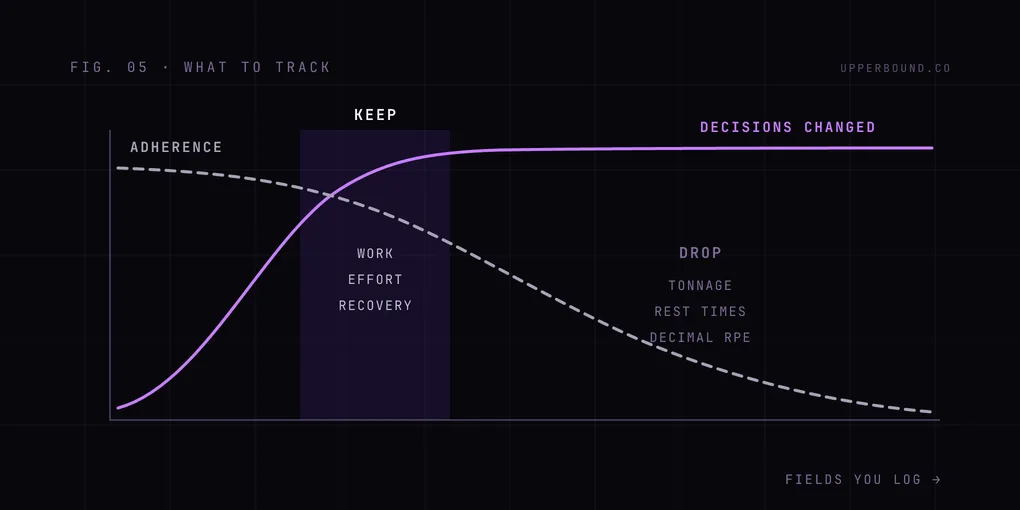
A training log is only worth keeping if you act on it. That’s the whole test, and most logs fail it. They fill up with rest timers logged to the second, tonnage totals nobody adds up, and decimal-place RPE scores that never once changed what the next session looked like. The cost isn’t just clutter. The more fields you ask yourself to fill in, the less likely you are to fill in any of them. So this is a guide about subtraction: the short list of things worth recording, the longer list you can drop guilt-free, and how to turn what’s left into a feedback loop instead of a diary.
Key Takeaways
- A log exists to make next week’s training better, not to record history. If a number has never changed a decision, stop tracking it.
- The short list is small: the work (exercise, load, reps, sets), the effort (reps in reserve on your top set), and a light recovery read (sleep, any nagging joint). That covers most calls.
- Track for adherence, not completeness. In a 2025 trial, self-guided lifters stuck to the plan only 52% of the time versus 88% supervised (JSCR, 2025). A log you actually fill in beats a perfect one you abandon.
- Some logged numbers are measured and some are estimated. Respect the difference: a load-velocity 1RM estimate carries about 10% error (Sports Medicine, 2023).
What is a training log actually for?
A log exists to make your next decision better, not to preserve the past. If a field never changes what you do next week, it’s clutter, and clutter has a real cost: it makes the whole habit heavier and easier to drop. Treat the log as your dataset. Training is a data problem, and the log is where you collect the data the measure, adjust, repeat loop runs on.
The cheapest structure you can give yourself is also the most underrated one: a record you actually keep. In 2025, a randomized trial comparing supervised, app-guided, and self-guided lifters over ten weeks found adherence dropped off a cliff without structure, landing at 88.2% supervised, 81.2% app-guided, and just 52.2% for the self-guided group (Journal of Strength and Conditioning Research, 2025). The log is the structure most of us can give ourselves for free. That only works if it’s light enough to stick with, which is the argument for tracking less, not more.
What should you actually track?
Track three things: the work, the effort, and a light recovery read. That short list drives almost every decision you’ll make, and most of what people add beyond it is noise. Here’s each one and why it earns the space.
The work
Record the exercise, the load, the reps, and the sets. This is the non-negotiable core, because it’s the only way to know whether you’re actually progressing or just showing up. The unit that matters most for growth isn’t tonnage, it’s hard sets per muscle per week, so log in a way that lets you count that. If you’re not sure what those numbers should be, set them from how much volume you actually need first, then let the log tell you when to move them.
The effort
Log how hard the top set was, in reps in reserve: how many more reps you could have made before failure. This is the single most useful subjective number you can record, and it isn’t just a feel thing. When researchers validated the RIR scale, bar speed tracked reported effort almost perfectly in trained lifters, an inverse correlation around negative 0.88 between velocity and RPE (Zourdos et al., JSCR, 2016). One RIR number per working exercise is plenty. If you want the full method, I wrote a guide to rating effort with reps in reserve.
The recovery read
Note two things, briefly: how you slept and whether anything hurts that shouldn’t. Not a wellness journal, just a flag. Sleep is the input that moves readiness the most, so a one-word note on a rough night explains a lot of bad sessions before you blame the program. The mechanism is worth understanding, so it’s worth knowing how sleep affects recovery rather than guessing. A nagging elbow that aches before you’ve touched the bar belongs in the log too, because that’s the kind of signal that turns into a layoff when you ignore it.
That’s the list. Notice it fits on one screen. My opinion, and I’ll flag it as opinion: the number of fields in your log is inversely related to how reliably you fill it in. Every extra column is a small tax you pay every session, and you’ll quietly stop paying it. A log you maintain for a year beats a perfect one you abandon in March.
What can you safely ignore?
You can drop most of the metrics that feel rigorous but never change a decision. For a natural intermediate lifter, that’s a long list, and cutting it is the point. Here are the usual suspects.
- Rest timed to the second. Resting “about two to three minutes” is fine. Logging 2:47 tells you nothing you’ll act on.
- Tonnage as a headline number. Total weight moved goes up when you add junk sets, so it rewards exactly the behavior you’re trying to avoid. Hard sets per muscle is the number that matters.
- Daily bodyweight. Track the weekly trend if you care about weight, not the daily noise that swings two pounds on water and salt.
- Decimal-place RPE. Rating a set 8 versus 8.5 is false precision. Your read isn’t that fine, and pretending it is wastes attention.
- Every warm-up set. Log your working sets. Nobody ever made a better decision because they recorded their second empty-bar warm-up.
I tracked most of these for years, to one decimal place, in a spreadsheet I was quietly proud of. I’ve been lifting seriously for about four years and still consider myself a beginner, but here’s what those years taught me about the spreadsheet: I never once opened it to decide anything. The rest times and tonnage totals were theater. The only fields I actually used were load, reps, the occasional RIR note, and “left shoulder cranky again.” The rule that fell out of that: if you’ve never changed your training because of a number, stop recording it.
How accurate are the numbers you log?
Some of your logged numbers are measured and some are estimated, and the estimated ones carry more error than people assume. This matters because it tells you which numbers to trust when they disagree. A measured rep count is solid. A derived one-rep max is a guess with a margin.
Take velocity tracking, which sells itself as objective. It can be, but it depends entirely on the tool. A 2024 study in PLoS ONE tested three phone apps for measuring barbell speed against lab motion capture and found the spread was huge: the best app performed as well as a dedicated linear transducer, while another missed 168 bench press reps it should have counted (PLoS ONE, 2024). “I tracked bar speed” means nothing until you know the app was any good.
Estimated maxes deserve the same skepticism. A 2023 meta-analysis of individualized load-velocity profiles, pooling 434 lifters across 20 studies, found predicted one-rep maxes carried a standard error of estimate around 9.8%, and recommended testing a true max when precision actually matters (Sports Medicine, 2023). On a 140 kg lift, that’s a band of plus or minus 14 kg. Useful for tracking trends, useless for picking an exact opener.
Your RIR estimate has a known weak spot too. It’s accurate close to failure and drifts when you guess from far away: research on proximity to failure found intraset RIR predictions were most accurate within a rep or two of the wall (JSCR, 2019). Practical translation: trust your effort read more on hard top sets than easy back-offs, and trust the measured numbers over the estimated ones whenever they fight.
How do you turn the log into a feedback loop?
Read the log weekly, not daily, and let it change exactly one thing. The daily entry is just data collection. The decision happens when you look back over the week and ask what the numbers are telling you. A log you never review is a diary, and a diary doesn’t train anyone.
The read is simple. Did the work go up, hold, or slide? Was effort creeping toward failure on weights that used to feel easy? Did the recovery flags pile up? Those answers feed straight into the four-signal, green-yellow-red decision in the autoregulating volume loop: add a little, hold, or back off. The log is what makes that call honest instead of a vibe.
This is also why one log beats five trackers. Effort, volume, and sleep all land in the same place, next to the work they explain, so the connections are visible. When you eventually add the progression rule you’re tracking against, or decide a planned back-off is overdue, those live in the same log too. One dataset, read once a week, pointed at one decision. That’s the entire job.
What does a minimal log look like?
Keep it to what you’ll act on. Here’s the trimmed version against the bloated one, so the contrast is obvious.
Track this:
- Exercise, load, reps, sets (enough to count hard sets per muscle per week)
- Reps in reserve on the top set
- Sleep note and any pain flag, one word each
Ignore this:
- Rest timed to the second
- Tonnage as a headline metric
- Daily bodyweight swings
- RPE to the decimal
- Warm-up sets
Paper, notes app, or a dedicated tracker, it doesn’t matter. The best log is the one you’ll still be filling in a year from now. Pick the format that gets out of your way and protect the short list from creeping back into a spreadsheet you’ll abandon.
Frequently Asked Questions
Do I need to track every set?
No. Log your working sets, and record reps in reserve on the top set rather than every set. That’s enough to count hard sets per muscle per week, which is the volume number that actually matters, without turning each session into data entry you’ll eventually skip. Warm-ups don’t need a row.
Is tracking RPE or reps in reserve worth it?
Yes, with one caveat. The effort read is real: bar velocity tracked reported RPE almost perfectly in trained lifters, around negative 0.88 (Zourdos et al., JSCR, 2016). Just trust it more near failure than far from it, and don’t bother with decimal places your read can’t support.
Should I track my bodyweight every day?
Track the weekly trend, not the daily number. Daily bodyweight swings several pounds on water, sodium, and gut contents, none of which is training signal. A once-a-week average, or a trend line if your app does one, tells you what’s actually happening to your weight without the noise prompting bad decisions.
Do I need an app, or is paper fine?
Paper is fine. The tool doesn’t drive results, the habit does, and adherence is where most self-guided lifters fall short, hitting roughly 52% in a 2025 trial (JSCR, 2025). Pick whatever you’ll actually keep using. If a phone app measures bar speed, just confirm it’s accurate, because they vary a lot.
How long before the log tells me anything useful?
Give it a few weeks of consistent entries. One session is a data point; a month is a trend. You need enough history to tell a real plateau from a single bad day before the log can guide a decision. That’s also why a light log you sustain beats a detailed one you quit after two weeks.
The bottom line
A training log is a feedback instrument, not a scrapbook. Its job is to make next week better, and a number that has never done that job is just weight you’re carrying. Track the work, the effort, and a light recovery read. Ignore the rest with a clear conscience. Then actually read it, once a week, and let it move one thing.
The lifters who get the most out of logging aren’t the ones with the most columns. They’re the ones who kept a short log long enough for it to say something. Measure the few things that change decisions, drop the rest, and read the result. That’s the loop, and a log built for it will out-train any spreadsheet you abandon by spring.
Sources
- Optimizing Resistance Training Outcomes: Comparing In-Person Supervision, Online Coaching, and Self-Guided Approaches: A Randomized Controlled Trial, Journal of Strength and Conditioning Research, retrieved 2026-06-23, https://pmc.ncbi.nlm.nih.gov/articles/PMC12529976/
- Concurrent validity of novel smartphone-based apps monitoring barbell velocity in powerlifting exercises, PLoS ONE, retrieved 2026-06-23, https://pmc.ncbi.nlm.nih.gov/articles/PMC11575817/
- The Predictive Validity of Individualised Load-Velocity Relationships for Predicting 1RM: A Systematic Review and Individual Participant Data Meta-analysis, Sports Medicine, retrieved 2026-06-23, https://pmc.ncbi.nlm.nih.gov/articles/PMC10432349/
- Zourdos et al., Novel Resistance Training-Specific Rating of Perceived Exertion Scale Measuring Repetitions in Reserve, Journal of Strength & Conditioning Research, retrieved 2026-06-23, https://journals.lww.com/nsca-jscr/fulltext/2016/01000/novel_resistance_training_specific_rating_of.31.aspx
- Proximity to Failure and Total Repetitions Performed in a Set Influences Accuracy of Intraset Repetitions in Reserve-Based Rating of Perceived Exertion, Journal of Strength & Conditioning Research, retrieved 2026-06-23, https://pubmed.ncbi.nlm.nih.gov/30747900/